
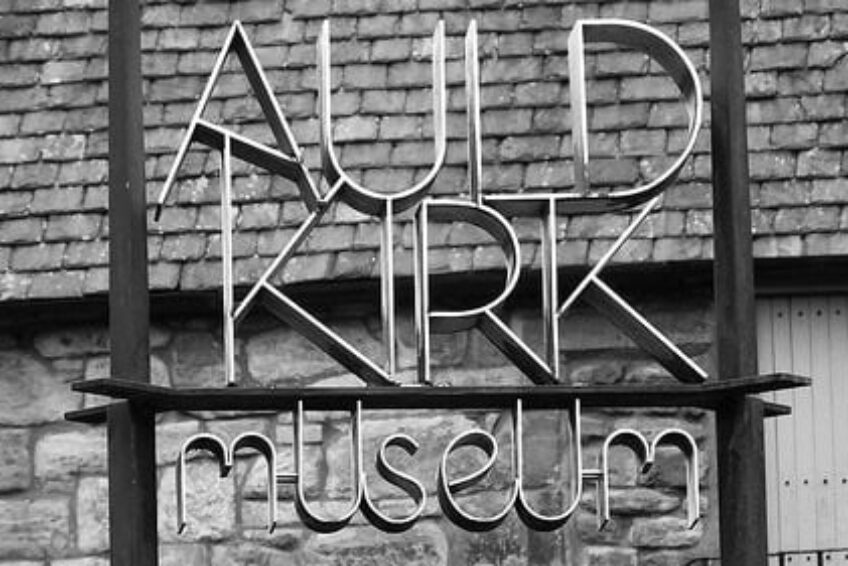
The Auld Kirk Museum has a permanent exhibition of Lion Foundry artefacts!
It also holds a large collection of the patterns used in the moulding process.
The iron foundry Lion Foundry started life in 1880 on the north bank of the Forth & Clyde Canal at Kirkintilloch as Jackson, Brown & Hudson. The site was adjacent to the Campsie Branch Railway, and was chosen with a view to receiving the delivery of raw materials by canal and sending out finished products by rail.
The firm was named Lion Foundry in 1885 and became a limited liability company in 1893.
Towards the end of the 19th century, the Lion Foundry range branched out from gates, railings, rainwater castings and other comparatively mundane products, into the field of constructional ironwork – elaborate bandstands, shelters, shopping arcades, verandahs and other such structures.
In the Moulding Shop, the patterns, often made up of many different components, would each be placed in a moulding box, set in sand in a very particular way. They were then removed to leave an appropriately shaped void in the fine sand.
The molten metal was poured into the sand mould.
After release from the moulding boxes, castings were taken to the Dressing Shop for removal of residual sand and surface impurities, and the smoothing of rough edges by means of grinding and smoothing equipment of various types, latterly including a “wheelabrator”. The multiple components of a foundry product were then taken to the Fitting Shop for assembly by fitters into the finished article.
The foundry employed large numbers of skilled craftsmen, designers and engineers as well as a larger workforce of labourers and ‘mates’ to support them. By 1910 about 500 workers were employed, one 20th of the population of the Burgh of Kirkintilloch. The fact that there were other foundries in the town meant that a pool of specialist labour was available locally.
Most of the workforce were local and lived in Kirkintilloch.
Local towns were built with extensive ornamentation in cast iron, including gates, railings, finials and weather vanes. Sadly, many of the local garden gates and railings were removed for scrap during World War II, but a great deal of ornamental ironwork survives at roof level on the villas of East Dunbartonshire.
In 1893 The Lion became a limited company and began to look at expanding its product range.
The employment of the foundry’s first designer, William Cassells, meant that they could consider more ambitious projects.
The period 1900-1914 saw the heyday of the Lion’s ornamental cast iron work.
The foundry was involved in large constructional ironwork projects in cities all over the UK, from Glasgow and Edinburgh to Manchester, London, Birmingham and Portsmouth. With the outbreak of war in 1914, the firm returned to producing more basic castings.
It also manufactured bombs and a special cupola was installed.
After the Wars, the firm stuck with a range of utilitarian products, including GPO telecommunication cabinets, pillar boxes, a variety of engineering castings and the distinctive new K8 type of red telephone kiosk!
Castings were shipped from Kirkintilloch to locations across the world.
The firm produced 12 gates and around 6000 feet of ornamental railings for a Prince’s residence in Bombay, several porticos for Indian banks, and the railings for Calcutta race course!
The Auld Kirk Museum is located in one of the finest and oldest sites in the town of Kirkintilloch – the grade A listed 1644 church and graveyard!
Check out the 360 tour – HERE!
The Auld Kirk Museum has a permanent exhibition of Lion Foundry artefacts!
It also holds a large collection of the patterns used in the moulding process.
The iron foundry Lion Foundry started life in 1880 on the north bank of the Forth & Clyde Canal at Kirkintilloch as Jackson, Brown & Hudson. The site was adjacent to the Campsie Branch Railway, and was chosen with a view to receiving the delivery of raw materials by canal and sending out finished products by rail.
The firm was named Lion Foundry in 1885 and became a limited liability company in 1893.
Towards the end of the 19th century, the Lion Foundry range branched out from gates, railings, rainwater castings and other comparatively mundane products, into the field of constructional ironwork – elaborate bandstands, shelters, shopping arcades, verandahs and other such structures.
In the Moulding Shop, the patterns, often made up of many different components, would each be placed in a moulding box, set in sand in a very particular way. They were then removed to leave an appropriately shaped void in the fine sand.
The molten metal was poured into the sand mould.
After release from the moulding boxes, castings were taken to the Dressing Shop for removal of residual sand and surface impurities, and the smoothing of rough edges by means of grinding and smoothing equipment of various types, latterly including a “wheelabrator”. The multiple components of a foundry product were then taken to the Fitting Shop for assembly by fitters into the finished article.
The foundry employed large numbers of skilled craftsmen, designers and engineers as well as a larger workforce of labourers and ‘mates’ to support them. By 1910 about 500 workers were employed, one 20th of the population of the Burgh of Kirkintilloch. The fact that there were other foundries in the town meant that a pool of specialist labour was available locally.
Most of the workforce were local and lived in Kirkintilloch.
Local towns were built with extensive ornamentation in cast iron, including gates, railings, finials and weather vanes. Sadly, many of the local garden gates and railings were removed for scrap during World War II, but a great deal of ornamental ironwork survives at roof level on the villas of East Dunbartonshire.
In 1893 The Lion became a limited company and began to look at expanding its product range.
The employment of the foundry’s first designer, William Cassells, meant that they could consider more ambitious projects.
The period 1900-1914 saw the heyday of the Lion’s ornamental cast iron work.
The foundry was involved in large constructional ironwork projects in cities all over the UK, from Glasgow and Edinburgh to Manchester, London, Birmingham and Portsmouth. With the outbreak of war in 1914, the firm returned to producing more basic castings.
It also manufactured bombs and a special cupola was installed.
After the Wars, the firm stuck with a range of utilitarian products, including GPO telecommunication cabinets, pillar boxes, a variety of engineering castings and the distinctive new K8 type of red telephone kiosk!
Castings were shipped from Kirkintilloch to locations across the world.
The firm produced 12 gates and around 6000 feet of ornamental railings for a Prince’s residence in Bombay, several porticos for Indian banks, and the railings for Calcutta race course!
The Auld Kirk Museum is located in one of the finest and oldest sites in the town of Kirkintilloch – the grade A listed 1644 church and graveyard!
Check out the 360 tour – HERE!