
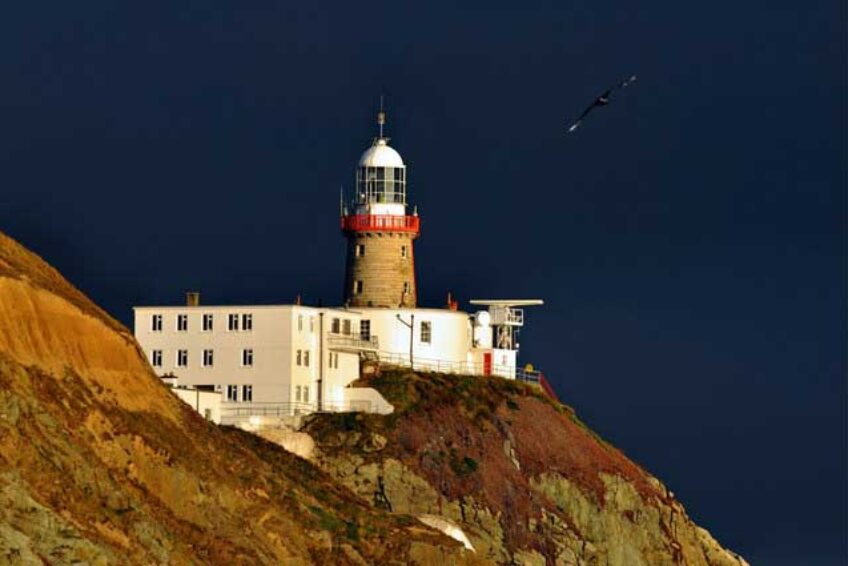
Baily Lighthouse was the last manned lighthouse in Ireland!
It was manned until 1996 and became a training facility!
The first lighthouse on this headland was built in about 1667 by Sir Robert Reading, and was 1 of 6 that Reading had instruction to build from Charles II. The original facility, up on the hill, consisted of a small cottage and a square tower which supported a coal-fired beacon. Would you believe, parts of the original buildings still remain!
In 1790, the coal beacon was replaced with a set of 6 Argand oil lamps, each with a silvered copper parabolic and a bulls-eye glass pane.
In 1810, the Corporation for Preserving and Improving the Port of Dublin took over the operations. Due to the heavy fog, a new, lower lighthouse was commissioned. A new tower and house for the keeper, designed by George Halpin Senior, was completed in March 1814.
The top of the tower stood 134 feet (41 m) above the sea, and the fixed white catoptric light was provided by a set of 24 Argand lamps and reflectors.
In 1865, the light source was improved from catoptric to first order dioptric.
At the same time, John Richardson Wigham had patented a gas-burning light, and experiments were tried at Baily. A gasworks was built at the station, first producing gas from oil, then shale, and finally rich cannel coal. The experiments were a success, and the system was added to nine other lighthouses!
An air horn was installed in 1871 for foggier times and that was upgraded with a siren in 1879.
Electrified came in 1972, with a 1,500 watt bulb in a rotating lens, producing a flash every 20 seconds.
The Baily lighthouse became a training facility for Supernumerary Assistant Lighthouse Keepers who would then transfer to other lighthouses.
The optic which was in use from 1902 to 1972 is now on display in the National Maritime Museum of Ireland.
Baily, Howth, Co. Dublin, Ireland.
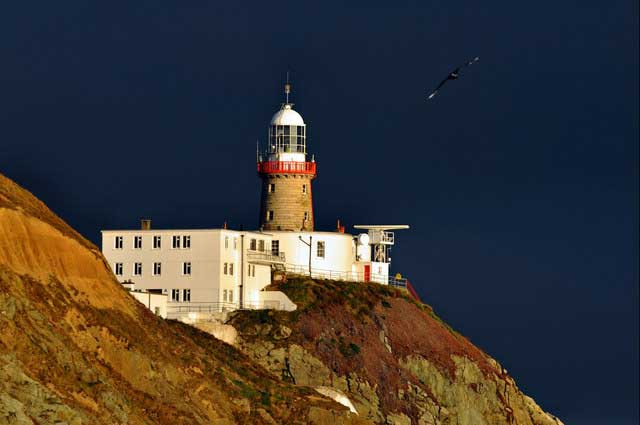
Baily Lighthouse was the last manned lighthouse in Ireland!
It was manned until 1996 and became a training facility!
The first lighthouse on this headland was built in about 1667 by Sir Robert Reading, and was 1 of 6 that Reading had instruction to build from Charles II. The original facility, up on the hill, consisted of a small cottage and a square tower which supported a coal-fired beacon. Would you believe, parts of the original buildings still remain!
In 1790, the coal beacon was replaced with a set of 6 Argand oil lamps, each with a silvered copper parabolic and a bulls-eye glass pane.
In 1810, the Corporation for Preserving and Improving the Port of Dublin took over the operations. Due to the heavy fog, a new, lower lighthouse was commissioned. A new tower and house for the keeper, designed by George Halpin Senior, was completed in March 1814.
The top of the tower stood 134 feet (41 m) above the sea, and the fixed white catoptric light was provided by a set of 24 Argand lamps and reflectors.
In 1865, the light source was improved from catoptric to first order dioptric.
At the same time, John Richardson Wigham had patented a gas-burning light, and experiments were tried at Baily. A gasworks was built at the station, first producing gas from oil, then shale, and finally rich cannel coal. The experiments were a success, and the system was added to nine other lighthouses!
An air horn was installed in 1871 for foggier times and that was upgraded with a siren in 1879.
Electrified came in 1972, with a 1,500 watt bulb in a rotating lens, producing a flash every 20 seconds.
The Baily lighthouse became a training facility for Supernumerary Assistant Lighthouse Keepers who would then transfer to other lighthouses.
The optic which was in use from 1902 to 1972 is now on display in the National Maritime Museum of Ireland.
Baily, Howth, Co. Dublin, Ireland.