
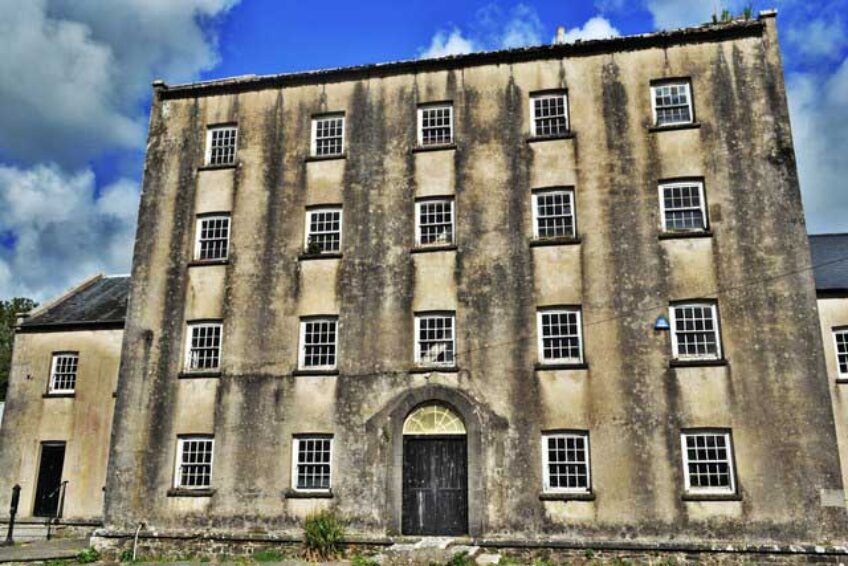
Blackpool Mill is an imposing 19th century water mill in Pembrokeshire, Wales.
It was fully operational until the Second World War and has survived with a full set of machinery.
Blackpool Mill is a 19th century flour mill and sits within a Site of Scientific Interest (SSSI) and a Special Area of Conservation (SAC).
It is a grade II* listed mill because it’s an exceptionally fine industrial building with a full working set of machinery.
Blackpool Mill was built in 1813 by Nathaniel Phillips, owner of the Slebech Estate, on the site of the former Blackpool Ironworks. Water for the wheel was brought from a distance of 0.5 km. The last section of the leat was contrived to approach the S face of the mill nearly on its central axis, for architectural effect.
The original water-wheel was beneath the main block of the mill – 4.5 m diameter and 3.5 m in width, on a wrought-iron shaft.
In 1842 John Butler became tenant of Blackpool Farm and Mill. He had problems with the water wheel and marks from the original wheel scraping against the stonework are visible in the basement. He also had trouble from rioters, who destroyed the floodgates in 1843!
At the turn of the century it was decided to renew the milling machinery and to remove the water-wheel in favour of a turbine. The new machinery was installed by Armfield of Ringwood, and continued in use until after the second World War.
In 1958 the mill was converted to electricity.
In 1968 a programme of restoration of the mill was commenced by Lady Victoria Dashwood to convert the mill to a tourist attraction. The left wing was converted to be the public entrance and shop, the right wing to be the tea-room. The mill machinery including the turbine was guarded, displayed and interpreted. One window of the left wing was converted to be a doorway and the main front door canopy was removed.
After many years of decline and decay there are now (2016) plans afoot to return the mill to a fantastic visitor attraction.
Views are being sought for a £2.5m project to restore the iconic Grade 2* listed Pembrokeshire mill to its Victorian heyday, which developers say will create 60 jobs and inject £1.6m into the local economy.
It is an ambitious, sympathetic restoration project to transform Blackpool Mill into an all-weather, Victorian-themed attraction with its own narrow gauge steam railway. Check out the article in the Telegraph – HERE!
Subject to planning permission, it is anticipated that work will get underway early in 2017, opening in Spring 2018.
There are lots of walks around the wider site and one can be found – HERE!
Martletwy, Narberth, Pembrokeshire SA67 8BL
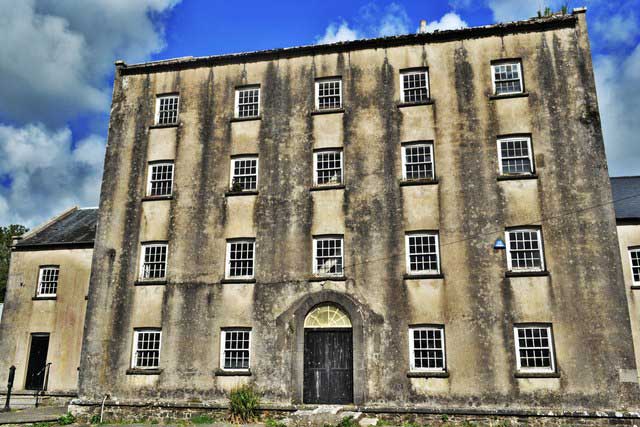
Blackpool Mill is an imposing 19th century water mill in Pembrokeshire, Wales.
It was fully operational until the Second World War and has survived with a full set of machinery.
Blackpool Mill is a 19th century flour mill and sits within a Site of Scientific Interest (SSSI) and a Special Area of Conservation (SAC).
It is a grade II* listed mill because it’s an exceptionally fine industrial building with a full working set of machinery.
Blackpool Mill was built in 1813 by Nathaniel Phillips, owner of the Slebech Estate, on the site of the former Blackpool Ironworks. Water for the wheel was brought from a distance of 0.5 km. The last section of the leat was contrived to approach the S face of the mill nearly on its central axis, for architectural effect.
The original water-wheel was beneath the main block of the mill – 4.5 m diameter and 3.5 m in width, on a wrought-iron shaft.
In 1842 John Butler became tenant of Blackpool Farm and Mill. He had problems with the water wheel and marks from the original wheel scraping against the stonework are visible in the basement. He also had trouble from rioters, who destroyed the floodgates in 1843!
At the turn of the century it was decided to renew the milling machinery and to remove the water-wheel in favour of a turbine. The new machinery was installed by Armfield of Ringwood, and continued in use until after the second World War.
In 1958 the mill was converted to electricity.
In 1968 a programme of restoration of the mill was commenced by Lady Victoria Dashwood to convert the mill to a tourist attraction. The left wing was converted to be the public entrance and shop, the right wing to be the tea-room. The mill machinery including the turbine was guarded, displayed and interpreted. One window of the left wing was converted to be a doorway and the main front door canopy was removed.
After many years of decline and decay there are now (2016) plans afoot to return the mill to a fantastic visitor attraction.
Views are being sought for a £2.5m project to restore the iconic Grade 2* listed Pembrokeshire mill to its Victorian heyday, which developers say will create 60 jobs and inject £1.6m into the local economy.
It is an ambitious, sympathetic restoration project to transform Blackpool Mill into an all-weather, Victorian-themed attraction with its own narrow gauge steam railway. Check out the article in the Telegraph – HERE!
Subject to planning permission, it is anticipated that work will get underway early in 2017, opening in Spring 2018.
There are lots of walks around the wider site and one can be found – HERE!
Martletwy, Narberth, Pembrokeshire SA67 8BL