
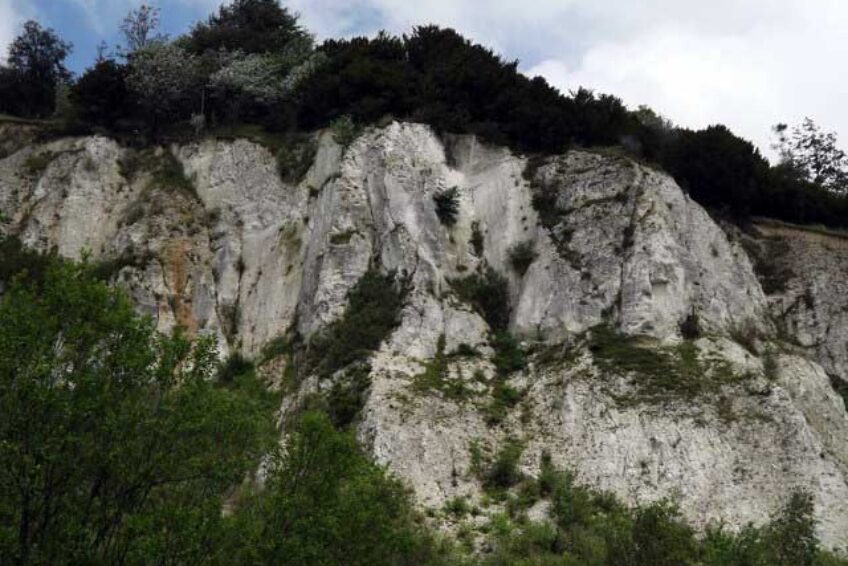
Brockham Lime Works has two important 19th-century lime kiln types – the flare kiln and the Brockham-patent kiln.
They are now encompassed in an interesting SSSI.
The Brockham Lime Works were built in the 19th Century to mine the hills of the North Downs. Chalk quarrying took place here for many years, before the expansion and lime-burning due to the opening of the South Eastern Railway between Redhill and Reigate, in 1849.
The 19th century flare kiln and Brockham Patent Kiln are considered by some to be among the most important industrial structures in Britain!
Surviving examples of Brockham-patent kilns are relatively rare and these are believed to be the best-preserved examples.
In 1889 Mr. Bishop patented a design for a continuously burning lime kiln, known as the `Brockham patent’ kiln, and most of the existing flare kilns at the works were suitably modified. The brick works there were closed in 1910 but the lime works continued in operation under the Brockham Lime and Hearthstone Comany Ltd, later a subsidiary of the Dorking Greystone Lime Company Limited.
In 1925 mining ceased and in 1936 the lime works finally closed.
The remains of the lime works include an eastern battery of 8 kilns, which is grade II listed, and a western battery of 2 kilns. Adjacent to these buildings are the remains of associated platforms and railways by which chalk was delivered to the kilns from the quarries in the north, and fuel was brought and quicklime carried out via the main line on the south.
Whilst the eastern battery survives largely intact, the partial deterioration of the western battery has revealed some structural details.
The Brockham-patent kiln is both well-documented and well-understood. The patent was internationally known and influenced the development of lime kilns worldwide.
It became a Site of Special Scientific Interest in 1975 and is situated in a local nature reserve on the course of the Pilgrims Way.
An area of the site was preserved by the Brockham Museum until the site’s stock of train engines were incorporated into a collection at Amberley Museum in 1982. As a result, the Industrial Railway Collection at Amberley has become one of the most important collections of industrial railway equipment in the UK!
Check out a walk – HERE!
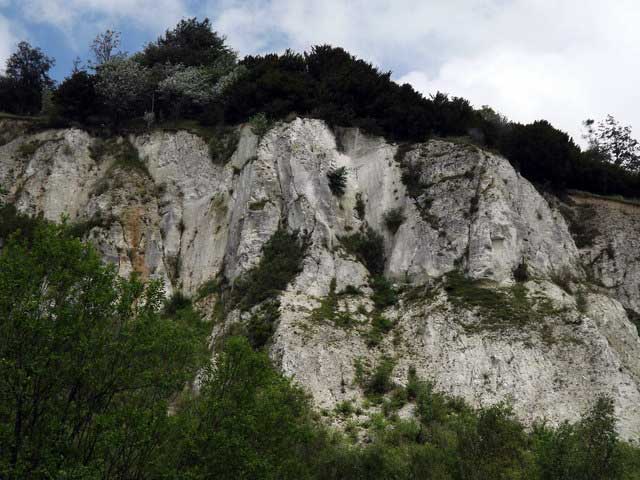
Brockham Lime Works has two important 19th-century lime kiln types – the flare kiln and the Brockham-patent kiln.
They are now encompassed in an interesting SSSI.
The Brockham Lime Works were built in the 19th Century to mine the hills of the North Downs. Chalk quarrying took place here for many years, before the expansion and lime-burning due to the opening of the South Eastern Railway between Redhill and Reigate, in 1849.
The 19th century flare kiln and Brockham Patent Kiln are considered by some to be among the most important industrial structures in Britain!
Surviving examples of Brockham-patent kilns are relatively rare and these are believed to be the best-preserved examples.
In 1889 Mr. Bishop patented a design for a continuously burning lime kiln, known as the `Brockham patent’ kiln, and most of the existing flare kilns at the works were suitably modified. The brick works there were closed in 1910 but the lime works continued in operation under the Brockham Lime and Hearthstone Comany Ltd, later a subsidiary of the Dorking Greystone Lime Company Limited.
In 1925 mining ceased and in 1936 the lime works finally closed.
The remains of the lime works include an eastern battery of 8 kilns, which is grade II listed, and a western battery of 2 kilns. Adjacent to these buildings are the remains of associated platforms and railways by which chalk was delivered to the kilns from the quarries in the north, and fuel was brought and quicklime carried out via the main line on the south.
Whilst the eastern battery survives largely intact, the partial deterioration of the western battery has revealed some structural details.
The Brockham-patent kiln is both well-documented and well-understood. The patent was internationally known and influenced the development of lime kilns worldwide.
It became a Site of Special Scientific Interest in 1975 and is situated in a local nature reserve on the course of the Pilgrims Way.
An area of the site was preserved by the Brockham Museum until the site’s stock of train engines were incorporated into a collection at Amberley Museum in 1982. As a result, the Industrial Railway Collection at Amberley has become one of the most important collections of industrial railway equipment in the UK!
Check out a walk – HERE!