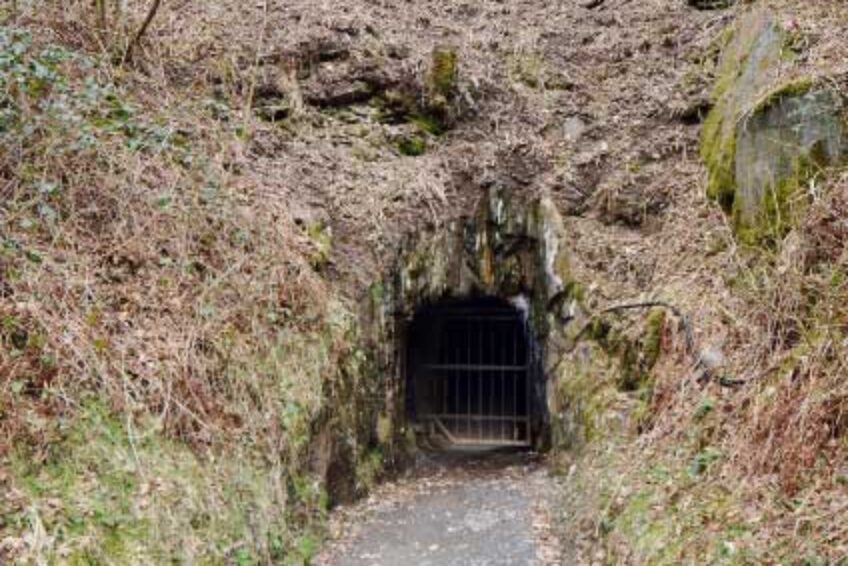


Dolaucothi Gold Mines are the only Welsh gold mines outside of the Dolgellau gold-belt.
They are also the only known Roman gold mines in Britain!
Obviously they are a Scheduled Ancient Monument!
The Dolaucothi Gold Mines are also known as the Ogofau Gold Mine. They are Roman surface and underground mines located in the valley of the River Cothi, near Pumsaint, Carmarthenshire, Wales.
Although the remains are predominantly Roman, which is good-enough, archaeology suggests that gold extraction on this site may have started sometime in the Bronze Age! The Bronze age people would probably have used the river panning method to separate the heavy grains of gold from the river gravels.
The Romans, although vastly more sophisticated, also employed water to power their gold-extraction enterprise. The area has the remains of extensive leat systems, including aqueducts to deliver the water power to the site of the extraction. The longest leat is about 7 miles or 11km long! There are also several large tanks for holding the water, still visible, above an isolated opencast pit carved in the side of the hill north of the main site.
Note: The simplest aqueducts are small ditches cut into the earth, but we are more familiar with the term being used for grand aqueduct bridges carrying canals over valleys!
The water was stored up in holding pits, then released at once to scour off the surface soils, revealing (hopefully) the heavier gold below. This method was known ad Hushing. The water supply of the aqueducts was also used for washing crushed gold ore, and for driving stamping mills.
This site yields some of the earliest evidence anywhere for the Roman use of water-powered trip hammers, to crush ore. The ore was probably crushed on the famous Carreg Pumsaint, which is a block of stone with the tell-tale markings of mining activity.
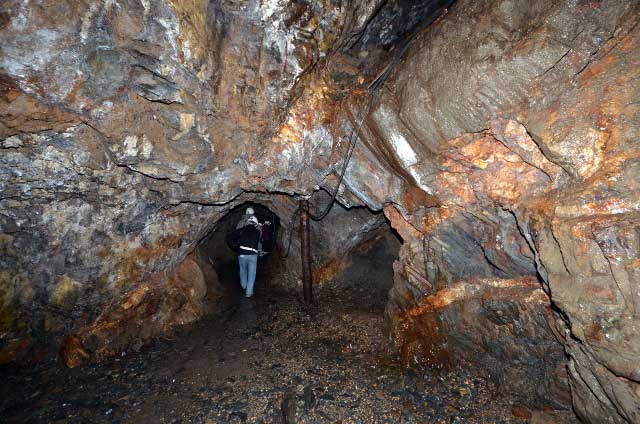
But the Romans didn’t just dig pits and channel water, they also went underground. They dug tunnels and adits to seek out the veins of gold. Some of the original pick-marks, which are almost 2,000 years old, can still be seen in the adits that are visited on the Roman Tour!
The Romans were active on the site in the 1st and 2nd century AD and coarse-ware and Samian ware pottery recovered from a reservoir (Melin-y-Milwyr) within the mine complex, show that activity at the mines continued at least until the late 3rd century!
The waterwheels were also used underground for dewatering! In 1935 part of a reverse overshot water-wheel was found underground, which is now in the National Museum of Wales. It was found with burnt timbers, suggesting that fire-setting was used to help break-up the hard quartz in which the gold was trapped.
When the Romans left, the mine lay abandoned for centuries!
There was a revival in the 19th century and attempts to make successful ventures at the site in the early 20th century, but they were abandoned before the first world war.

It is now a very important archaeological site and much more remains to be discovered for sure! It is cared for by the National Trust, so get your visiting information HERE!
Dolaucothi Estate, Pumpsaint, Carmarthenshire, Wales
Dolaucothi Gold Mines are the only Welsh gold mines outside of the Dolgellau gold-belt.
They are also the only known Roman gold mines in Britain!
Obviously they are a Scheduled Ancient Monument!
The Dolaucothi Gold Mines are also known as the Ogofau Gold Mine. They are Roman surface and underground mines located in the valley of the River Cothi, near Pumsaint, Carmarthenshire, Wales.
Although the remains are predominantly Roman, which is good-enough, archaeology suggests that gold extraction on this site may have started sometime in the Bronze Age! The Bronze age people would probably have used the river panning method to separate the heavy grains of gold from the river gravels.
The Romans, although vastly more sophisticated, also employed water to power their gold-extraction enterprise. The area has the remains of extensive leat systems, including aqueducts to deliver the water power to the site of the extraction. The longest leat is about 7 miles or 11km long! There are also several large tanks for holding the water, still visible, above an isolated opencast pit carved in the side of the hill north of the main site.
Note: The simplest aqueducts are small ditches cut into the earth, but we are more familiar with the term being used for grand aqueduct bridges carrying canals over valleys!
The water was stored up in holding pits, then released at once to scour off the surface soils, revealing (hopefully) the heavier gold below. This method was known ad Hushing. The water supply of the aqueducts was also used for washing crushed gold ore, and for driving stamping mills.
This site yields some of the earliest evidence anywhere for the Roman use of water-powered trip hammers, to crush ore. The ore was probably crushed on the famous Carreg Pumsaint, which is a block of stone with the tell-tale markings of mining activity.
But the Romans didn’t just dig pits and channel water, they also went underground. They dug tunnels and adits to seek out the veins of gold. Some of the original pick-marks, which are almost 2,000 years old, can still be seen in the adits that are visited on the Roman Tour!
The Romans were active on the site in the 1st and 2nd century AD and coarse-ware and Samian ware pottery recovered from a reservoir (Melin-y-Milwyr) within the mine complex, show that activity at the mines continued at least until the late 3rd century!
The waterwheels were also used underground for dewatering! In 1935 part of a reverse overshot water-wheel was found underground, which is now in the National Museum of Wales. It was found with burnt timbers, suggesting that fire-setting was used to help break-up the hard quartz in which the gold was trapped.
When the Romans left, the mine lay abandoned for centuries!
There was a revival in the 19th century and attempts to make successful ventures at the site in the early 20th century, but they were abandoned before the first world war.
It is now a very important archaeological site and much more remains to be discovered for sure! It is cared for by the National Trust, so get your visiting information HERE!
Dolaucothi Estate, Pumpsaint, Carmarthenshire, Wales