The Ticknall Limeyards are scattered across a rare slither of limestone amogst extensive coal measures in Derbyshire!
They are now owned and managed by the National Trust with the Calke Abbey Property.
The Thringstone Fault crosses the parish of Ticknall from east to west, separating the Coal Measures clays to the south from the upthrust Carboniferous Limestone to the north. Other outliers of limestone occur at Calke, Dimminsdale, Breedon and Cloud Hill, but otherwise limestone is fairly rare in the area.

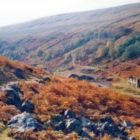
The Ticknall Limeyards are the property of the National Trust, Calke Abbey. The yards are a Site of Special Scientific Interest with a good variety of lime-loving plants for the botanist. The present luxuriant growth of vegetation was non-existent before the turn of the century. In the winter, “old man’s beard” (wild clematis) festoons the trees. Harts-tongue fern and the rare Hard shield fern occupy wet spots, and the ground cover is rich in Dog’s mercury and Ransomes (wild garlic). The purple orchid is common in places, together with wild strawberries but the bee orchid is now rarely seen.
The Lime Burning Process
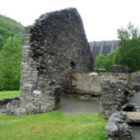
The kilns found in the Ticknall limeyards are representative of the type in use in the 18th and 19th centuries. They resemble an inverted oval cone, about 3.0 by 2.5 metres at the top, reducing to about 1.5 by 1.0 metres at the base. The base is converted into a tunnel with draw arches at each end to enable the burnt lime to be raked out of the kiln. The kilns were stacked with alternate layers of limestone from the quarries and slack coal. The coal was brought by horse tram from pits at Pistern Hills and Ashby Woulds and shovelled into the tops of the kilns from a high level tram track. Coal lumps were in demand for domestic use and it was perfectly satisfactory to use the smaller “slack” coal which was not suitable for the home fires. The base of the kiln was charged with brushwood or other inflammable material, this was ignited and the layers of coal up the kiln would burn in turn, converting the limestone to quicklime. The gases evolved included not only carbon dioxide from the limestone, but also sulphurous and other noxious fumes from the low grade local coal which was used. Pollution must have been dreadful. After about five days, all the coal would have burnt away and the kiln was left to cool for another five days and the quicklime raked out. The rate of burning was controlled by a sheet of iron placed over the top of the kiln. Some of the early kilns had square corners in the draw tunnel and workmen would have had to enter the kiln to empty it completely. As quicklime is corrosive to skin, eyes and lungs, one can only hope that the operators had some form of protection although it seems unlikely. The lime had to be kept dry to prevent it slaking and was shovelled into tram trucks on a low level track, which were presumably covered to keep the rain off. Blind tunnels in Cope’s Yard may have been used for storing burnt lime in dry conditions.The bases of the kilns in Sir Henry’s Yard had no square corners in their draw tunnels and could have been emptied without entering the kiln. It is thought possible that these kilns could have been worked continuously and charged at the top and discharged at the bottom without the need to cool down the kiln. Due to a lack of quality control, the product raked out of the kilns was very variable and included quicklime, unburnt limestone, slag, ashes and cinders. This was of no use for making mortar, so good lumps of quicklime were picked out by hand and the remainder was shovelled up for use on the land, where the presence of ashes and slag was unimportant. In the 17th century, shovelled lime was sold to Melbourne Hall at 3d. a strike whereas picked lime was 4d a strike. A strike is a somewhat indeterminate volume measure: commonly it seems to be half a bushel which is 4 gallons.Early Days in the Limeyards
The Constable of the Castle of Melbourne was purchasing limestone for the repair of the Bakehouse at the Castle and works at the Dam head in 1393; in 1411, limestone was purchased for repairing the water gate. It is probable that the stone came from Ticknall or Dimminsdale showing that the quarries were working at the time.Although we cannot tell when lime burning first started at Ticknall, two indentures in the Harpur-Crewe Archive at the Matlock Record Office show that it was operating in the fifteenth century. The first deed is dated 14th October, 1462, and is a lease from Ellen Assewall to Symon Ragg of a limekiln with houses between the lands of Thomas Fraunceys and the Cellarer of Calke Abbey. The lease was for 6 years at a rent of 45 shillings a year. The second deed is dated 1st May, 1476, and is a lease from William Abell to Robert Fraunceys of “a parcel of ground lying in the south field in Ticknall, that is to say in a place called the Lyme Kilns betwixt the land of the Prior of Repton upon the north part and that of Thomas Fraunceys on the south part…” Robert Fraunceys was allowed to “Dig and mine stone, occupy the said ground to his most profit, making of lime … with free passage coming and going with all manner of carriages to the land…” The lease was for the life of William Abell and the rent was 12 pence a year. It is of interest that both of these deeds were written in English at a time when Latin was normally used for documents.Just before the Dissolution of the Monasteries, in 1537, the Prior and Convent of Repton leased the land at Calke to John Priest, but the Prior reserved the right to burn lime in his kiln, which may have been at Calke, Dimminsdale or Ticknall.The lime yards continued to become more important into the seventeenth century. There was quarrying of the limestone from the area just south of Main Street, which was later referred to as the “Old Town Yard”. In 1630, Sir John Coke purchased 72 loads of lime from Gilbert Hutchinson of Ticknall at a price of 9 shillings per load, for building his new house of Melbourne Hall. A load would be a cart-load, weighing about a ton. Gilbert Hutchinson sired a long line of Gilbert Hutchinsons, who were all in the lime business for the next two hundred years. They were providing lime to Colonel John Coke of Melbourne in 1680 as well as Thomas Coke for the rebuilding of Melbourne Hall and Gardens in 1704.The inventory of John Crosse of 1644 includes 300 loads of limestone “allready gotten” with a value of £12.0s.0d. and stored on the waste. Crosse’s inventory included debts for lime and limestone already sold. Seventeenth century land terriers refer to land at Limekiln Flat, which is located along the lane leading to White Leys and shows that lime burning was occurring at this site. Land purchased by Sir John Harpur in 1690 included the Lime Kilns in Derby Way, in Knowle Hill Field. This is presumably the Paddock Wood area to the north of Main Street. In 1695, Francis Mee of Ticknall was paid by Sir John Harpur for getting limestone and burning it, some of which was used to repair Eaton’s house in Ticknall.Expansion of the Limeyards

The Peak of the Yards
The census returns for Ticknall show a population rise from 1125 in 1801 to 1241 in 1851 and then a steady fall to 630 in 1901. (The population at the pre-sent time [19951 is about 660.) This almost certainly reflects the rise and fall of employment in the limeyards. The opening of the tramway in 1802 gave impetus to an increase in the production of lime. The cheap transport now available with access to the Ashby Canal meant that lime could be supplied outside the immediate area of Ticknall. In 1813, John Farey observed that “…Great quantities of this stone are sent away southward by the Railway Branch to the Ashby-de-la-Zouch Canal in Willesley…” Much of the central portion of the limeyards had already been worked out and expansion was pursued in all directions except to the east where the limestone was overlaid by coal measures and Calke Park barred any progress.
The Margarets Close Company
The Margarets Close Company was soon in trouble; it appears to have over capitalised itself. In 1802, the company sold £15 worth of lime for building Mr. Briggs’ new house in Kings Newton (now Elms Farm). An inventory was taken by the solicitor, Edward Mammatt of Measham, in January, 1802. This showed that the amount of money borrowed to finance the enterprise was £1440.19s.6d. whereas the money due was only £1000, leaving the company in deficiency. The steam engine with its pump trees, timbers and framing over the pit was valued at £550, 180 yards of iron railway at £94 and four lime kilns at £63. The assets included lime kilns at Ashby Woulds which were to be paid for either by Lord Moira or Mr. Wilkes. The company could only be made profitable by further borrowing and a target production of 12,000 tons of stone and 8,000 tons of lime per annum. It then seems to have gone bankrupt and this was confirmed when the area was excavated in 1987 by the Leicestershire Industrial History Society. One of the kilns excavated was found to he rebuilt from old materials but never fired. Along the top of the kilns were the remains of a narrow-gauge tramway, of 21 inch gauge, in distinction to the main Ticknall Tramway which was 4 ft. 2 ins. gauge. Joseph Butler of Wingerworth was producing narrow gauge railways of this type in 1788.Sir Henry Harpur’s Yard
This was the central portion of the limeyards created by the Enclosure Award of 1765. As the owners of the other limeyards encountered financial or other difficulties, the Harpur-Crewe family were able to take over these yards and add them to their own, until they owned the whole area. Richard Sale’s yard was taken over in 1807 and the Burdett yards in the 1820’s. Gilbert Hutchinson was imprisoned for bankruptcy in 1833 and John Cope, who was heavily in debt, sold out to Sir John Harpur. By the middle of the nineteenth century, the Harpur Crewes had a monopoly of lime production, and the yards were leased to tenants.The main tenant was originally Rowland Ordish who became the largest operator and in 1838, was burning 700 kilns a year, requiring 21,000 tons of limestone rock John Foster leased Cope’s Yard and burned about 100 kilns a year. Foster’s lease was withdrawn in 1843 and John Cope’s brother Thomas, took over the working of Cope’s Yard. The 1851 Census Return lists two limeburners: Thomas Cope who employed 10 men and Rowland Ordish who employed 36 men. Ten years later, both of these had disappeared and the sole remaining lime-burner was William Garrard who employed 18 men. Garrard worked the yards under the title of the Ticknall Lime Company. The Ordnance Survey map of 1882 shows 13 kilns with the tramway feeding a series of spurs to the tops of the kilns for unloading coal slack, and to the bottoms of the kilns for loading trucks with burnt lime. There were no other kilns elsewhere in the yards and it seems that the kilns in Sir Henry’s Yard dealt with all the limestone from the area.Paddock Wood
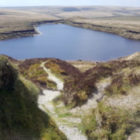
These quarries were located north of Main Street and may have been opened up after the 1765 Enclosure Award. The 1843 Tithe Apportionment map and schedule show that the Paddock Lime Quarries were worked by Rowland Ordish. John Shaw’s 1857 map of Ticknall parish shows a horseshoe of eight kilns, with the tenancy held by William Garrard who also was working Sir Henry’s Yard. Archaeological investigation by The Leicester Industrial History Society revealed that this yard was in a very chaotic and ruinous state but the remains of seven kilns were identified.The Burdett limeworks lay to the east of Paddock Wood. They were purchased by Sir George Crewe who built there a brickyard which is marked on the 1843 map, the 1857 map and on the 1882 Ordnance Survey map. This brickyard was then demolished and a new brick kiln, clay mill and drying shed built to the east. This new yard is marked on the 1899 O.S. map and much of it still stands today. Apart from flooded quarries, no signs remain of Sir Francis Burdett’s lime-works.Cope’s Yard
Thomas Cope acquired land to the east of the main limeyards and the lane to White Leys farm towards the end of the eighteenth century. He had an agreement to open up limestone quarries and build kilns to make lime for sale. Cope built a battery of four kilns overlooking the quarry known as Dick’s Pit. The draw 12 arches below the kilns were connected by tunnels such that two adjoining kilns could be raked out into the same access tunnel. The Ashby tramway was extended from the Paddock Wood quarries near the “Royal Oak” along Main Street to Cope’s Yard. Parts of the tramway can still be recognised running along an embankment above the range of four kilns and between Portobello Pit and Dick’s Pit. Thomas Cope sold 3 tons of lime to Melbourne Hall in 1831 for £1.3s.6d.
The Decline of the Yards
By the middle of the nineteenth century, the Harpur-Crewe family had obtained a complete monopoly of the Ticknall limeyards which were then leased out to a single tenant. Originally, this was Rowland Ordish, who was replaced in 1857 by William Garrard trading under the name of the Ticknall Lime Company. The Paddock Wood and the western limeyards were abandoned and quarry extensions were made in the south-east of the area, around Riley’s Close and Portobello Pit. A new method of quarrying was attempted, in which high quality limestone was mined by penetrating into the rock face, leaving an over burden of impure limestone which was supported by pillars of rock which were left standing. When abandoned, these caves formed popular picnic spots with the local inhabitants, but this practice ceased with the collapse of one of the caves, known as the “Dripping Wells”, in 1952.By this time, the railway mania was sweeping the country and lines were built to places such as Buxton and Matlock, which enabled the produce of quarries in the Peak District to be transported by steam train all over the country. Ticknall with its primitive horse drawn tramway was unable to compete. There were technological advances in kiln design, and the primitive vertical kilns were replaced by horizontal kilns, which were heated indirectly to give a product lime which was not contaminated with coal ash and clinker.
To enjoy the yards today, head for Calke Abbey with your National Trust cards. See details of the Ticknalls Limeyards Walk – HERE!