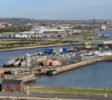
Barry Docks are a port facility in the town of Barry in South Wales and by 1913, were the busiest coal port in the world!
They were built to provide an alternative to Cardiff Docks, to ship coal carried by rail from the South Wales Coalfield.
The principal engineer for Barry Docks was John Wolfe Barry, assisted by Thomas Forster Brown and Henry Marc Brunel, son of the famous engineer Isambard Kingdom Brunel.
They were opened in 1889 and a 2nd dock and entrance lock were added in 1898.
Barry Dock Offices were built in 1897-1900 by the architect Arthur E. Bell.
In 1909 about 8,000 women and 10,000 men were employed in the docks, and by 1913, the docks were the busiest coal port in the world, exporting 11.05 million long tons (11,230,000 t; 12,380,000 short tons) at peak. Coal exports declined after World War I (1914–18). Strikes and the Great Depression of the 1930s caused further problems.
Parts of the docks have become industrial estates such as the Atlantic Trading Estate, and the area around the first dock, now called The Waterfront, has been redeveloped for residential and commercial use. The second dock is still active and generally handles chemicals and timber.